We Are the Soil: The Real Root of the Disease Crisis
What drives disease as a whole in our society is something deeper: our inability to see ourselves as part of nature. We've drawn a line between ourselves and the living world that doesn't actually exist. Herbicides accelerate and compound a breakdown that was already happening in the soil, in the plant, and ultimately in us. Until we address that breakdown at its source, we'll keep treating symptoms while the underlying problem grows
David King
2/24/20266 min read
We Are the Soil: The Real Root of the Disease Crisis
By David King,
Executive Director, ORCA — Organic Regenerative Certified Apprenticeship
There's a lot of media right now about defense dollars being redirected toward glyphosate production and immunity. People are rightfully concerned. And yes — glyphosate causes harm. Paraquat causes harm. The three to five additional herbicides manufacturers now have to stack with glyphosate — because it no longer works as well as it once did — those cause harm too. These chemicals are part of the problem, and we should say so clearly.
But they're not the root of the problem. They're a symptom of it.
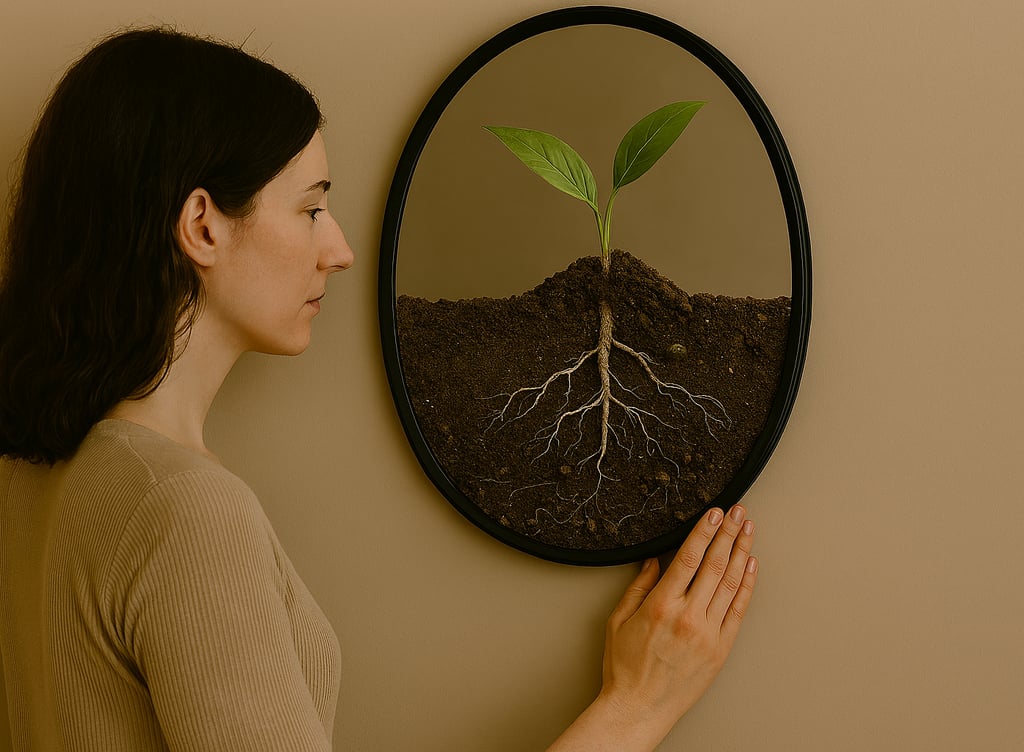
What drives disease as a whole in our society is something deeper: our inability to see ourselves as part of nature. We've drawn a line between ourselves and the living world that doesn't actually exist. Herbicides accelerate and compound a breakdown that was already happening in the soil, in the plant, and ultimately in us. Until we address that breakdown at its source, we'll keep treating symptoms while the underlying problem grows.
There Is No Line Between Living Soil, Living Plant, and Living Human
Think about a tomato. To get a commercially grown tomato to harvest, it may receive twelve or thirteen separate spray applications. We work incredibly hard to get that plant to market — because left alone, it wouldn't make it. Nature would take it out: fungus, mites, aphids, beetles.
These aren't random pests. They're responding to real signals. When a plant is stressed, deficient in minerals, and lacking the internal biology it needs, it produces fewer of the volatile organic compounds that make it resilient. Pest pressure increases because the plant is genuinely compromised — nature is doing exactly what it's designed to do with material that isn't suitable for higher digestion.
So we spray. We spray again. We get the tomato to the shelf.
And then we eat it.
That tomato doesn't have the minerals it needs. It doesn't have the microbiology it needs — inside the plant, on the plant, surrounding the roots. It lacks the phenols, the organic acids, the complex compounds that would make it resilient. We've taken a plant that couldn't survive on its own and treated it as food.
Now here's the part that changes everything: you are made of plants.
Whether you eat plants directly or eat animals that eat plants, your body is built from what the plant contains. The same ions in the soil move into the plant. The same ions in the plant move into you — into your enzymes, your bones, your tissue, the sequences in your DNA. When those ions are missing from the soil, they're missing from the plant. When they're missing from the plant, your body tries to build without them. This is where the damage compounds: the body doesn't simply go without — in some cases a heavy metal occupies the binding site where an essential mineral should be, the enzyme doesn't form correctly, and the biological sequence doesn't complete. This is a known mechanism, not a hypothesis.
The microbiology in the soil is the same microbiology that lives inside the plant and on the plant. The microbiology in and on the plant is the same microbiology inside you and on you. It's one continuous system. We are not separate from it. We are it.
There is no line between living soil, living plant, and living human.
We Are at the Bottom of the Food Chain — Not the Top
The popular interpretation of Darwinism — amplified through neo-Darwinism and the sociobiology movement — placed humans at the top of the food chain. But that's a cultural story we told ourselves, not what Darwin actually observed. His work described webs of interdependence, not a hierarchy with us at the summit.
The ecological reality is the opposite of what we've been taught. Remove humans from an ecosystem, and it rebounds into abundance remarkably quickly. Remove the plants, and we're gone within a short time. A forest doesn't need us. We need the forest.
This isn't abstract. Walk away from a farm for five years and watch what happens — nature reclaims it in short order, and with greater productivity and biodiversity than what we managed. The plants are not dependent on us. We are entirely dependent on them.
For us to be healthy, plants need to be expressing their highest genetic potential — the full spectrum of nutrients, compounds, and biological activity they're capable of producing. For plants to reach that potential, the soil must be alive. It must have the right mineral balance, the biology to cycle nutrients, and the microbial life to synthesize complex compounds — so the plant doesn't have to spend its energy on basic survival chemistry. When the soil is rich and biologically active, the plant invests its energy in terpenes, phenols, and the deeper compounds that make it both pest-resistant and deeply nutritious. That nutritional depth is what moves through the food chain into us.
Soil health is human health. There is no separation.
We've Become a Reflection of Our Food
When we grow plants that can't survive on their own and then eat them, we become a reflection of those plants. We become people who can't thrive on our own — people who need pharmaceutical interventions to manage conditions that shouldn't exist in the first place.
Consider the other signals we've normalized: even people who consider themselves healthy rely on daily supplements to fill nutritional gaps that food should be providing. Governments worldwide have resorted to fortifying staple foods — adding back iron, iodine, folate, vitamin D — because the food supply can no longer deliver what the human body requires. We've accepted this as progress. It isn't. It's a workaround for a broken system. When a society has to fortify its bread to prevent birth defects, that's not nutrition science succeeding — that's agriculture failing.
The pesticides are part of this system failure — they both respond to depleted soil and deepen it. But they're not where the chain starts. The chain starts with our decision, generation after generation, to treat soil as a substrate rather than a living system, and to treat plants as a production problem rather than the foundation of human health.
The solution, at its core, isn't complicated. Regenerate the soil. Grow plants strong enough to stand on their own. Eat those plants. The rest follows.
You are not separate from the plant. You are the plant. You are the soil.
Modern Science Is Catching Up to What Regenerative Farmers Have Always Known
In September 2024, the National Academies of Sciences, Engineering, and Medicine — the institution that has advised Congress and federal agencies on science policy since Abraham Lincoln signed its charter in 1863 — published a landmark report commissioned by USDA: Exploring Linkages Between Soil Health and Human Health.
Its conclusions are worth stating plainly.
The report formally acknowledges that soil biological properties "were largely omitted during most of the 20th century, likely to the detriment of soil health and long-term sustainability." It identifies the living microbial community in soil — bacteria, fungi, archaea, protozoa — as the driver of virtually all critical soil processes: nutrient cycling, organic matter decomposition, disease suppression, and soil structure. It recommends that microbial measurements be included in standard soil health assessments. And it documents contaminant pathways from soil through plants to human exposure, with particular concern for vulnerable populations.
In short: the highest level of U.S. federal science has formally concluded what regenerative practitioners have understood through decades of field experience — that the soil, the plant, and the human are one interconnected system, and that managing soil as a living organism rather than a chemical substrate is foundational to human health.
This isn't a fringe position. It's USDA's own commissioned science. ORCA's training methods, soil assessment protocols, and farm-to-school safety standards are built on exactly this foundation.
What ORCA Is Doing About It
This isn't theory for us — it's the daily work.
At ORCA — the Organic Regenerative Certified Apprenticeship program — we train the next generation of farmers and land stewards to work with this system, not against it. Our apprentices learn precision soil chemistry, microscope-based soil biology assessment, and how to grow food that is genuinely strong: food that doesn't need twelve spray applications to make it to harvest, food grown in living soil, food that nourishes the people who eat it at the cellular level.
Our particular focus is on operations serving the people most affected when this system breaks down — children in farm-to-school programs, patients in hospitals, people in correctional facilities. These populations don't have the luxury of absorbing the consequences of compromised food. They need us to get this right.
We believe the health of the soil, the plant, the farmer, and the community are inseparable. That's the science and the practice of regenerative agriculture — and it's what we teach.
To learn more about ORCA's apprenticeship program and our work across California, visit [orca-apprenticeship.org].
David King is a second-generation back-to-the-lander based in Mendocino County, California, with nearly three decades of experience in precision soil chemistry, microscope-based soil biology assessment, and parts-per-billion contamination testing. He is Executive Director of ORCA — California's only dual-certified state and federal regenerative agriculture apprenticeship program — and Principal of Surprise Valley Agroecology LLC.