The Hidden Chemistry Crisis in School Gardens: How "Natural" Fermentation Practices Are Creating Heavy Metal Exposure
Across educational institutions and sustainable agriculture programs, a dangerous misunderstanding is spreading through well-intentioned communities. Fermentation—celebrated as a traditional, natural practice—is being applied to hyperaccumulator weeds and organic materials without understanding the profound chemical transformations that occur. What appears to be biological recycling is often the creation of highly concentrated heavy metal delivery systems.
David King
3/11/202613 min read
The Hidden Chemistry Crisis in School Gardens: How "Natural" Fermentation Practices Are Creating Heavy Metal Exposure
A comprehensive analysis of heavy metal bioavailability, fermentation risks, and the regulatory gaps putting vulnerable populations at risk
The Crisis in Plain Sight
Across educational institutions and sustainable agriculture programs, a dangerous misunderstanding is spreading through well-intentioned communities. Fermentation—celebrated as a traditional, natural practice—is being applied to hyperaccumulator weeds and organic materials without understanding the profound chemical transformations that occur. What appears to be biological recycling is often the creation of highly concentrated heavy metal delivery systems.
Children in school gardens, patients in hospital growing programs, and other vulnerable populations are being exposed to mobilized lead, arsenic, cadmium, and other toxic metals through practices that sound beneficial and appear environmentally responsible. The exposure pathway is invisible to existing regulatory frameworks, and the chemistry is complex enough that practitioners remain unaware of the risks they're creating.
This comprehensive analysis examines the scientific mechanisms behind these dangerous transformations, the regulatory gaps that allow them to persist, and the evidence-based solutions needed to protect vulnerable populations while preserving legitimate sustainable agriculture practices.
Understanding Soil Redox: The Foundation of Metal Behavior
What is Redox Potential?
Redox potential, measured in millivolts (mV), tells us how strongly a system wants to gain or lose electrons. Think of it as the 'electron pressure' in soil or compost. This single measurement reveals whether heavy metals are locked up safely or mobilized into dangerous forms.
Redox is measured with a platinum electrode that reads the electrical potential of the soil solution. The higher the reading, the more oxidizing (aerobic) the conditions. The lower the reading, the more reducing (anaerobic) the conditions.
The Critical Thresholds for Heavy Metal Safety
Different redox levels trigger specific heavy metal transformations. Understanding these thresholds is essential for any soil management involving potentially contaminated materials:
Above +400 mV: Aerobic Safety Zone
Chemical environment: Aerobic, oxygen present, iron and manganese oxides stable
Heavy metal behavior: Metals bound to soil particles, low bioavailability, safe
+200 to +400 mV: Transition Zone
Chemical environment: Oxygen patchy, manganese begins reducing
Heavy metal behavior: Early metal mobilization, especially manganese and cobalt
0 to +200 mV: Danger Zone
Chemical environment: Anaerobic, iron oxides dissolving, reducing conditions
Heavy metal behavior: Lead, arsenic, cadmium mobilizing. Arsenate → arsenite conversion
Below 0 mV: Extreme Danger
Chemical environment: Sulfate reduction, H₂S production, extreme anaerobic conditions
Heavy metal behavior: Maximum toxicity: methylmercury formation, lead sulfate dissolution
The 400 mV Principle
The 400 mV threshold is the safety line. Above 400 mV, most heavy metals stay bound and immobilized. Below 400 mV, metals begin mobilizing into their most toxic and bioavailable forms.
Why Fermentation Crashes Redox
Fermentation is fundamentally an anaerobic process. When plant material ferments, oxygen is rapidly consumed by microbial activity, and the redox potential drops dramatically—often to -200 to -400 mV. This puts the system deep into the reducing range where heavy metals undergo their most dangerous transformations.
The organic acids produced during fermentation (acetic acid, lactic acid) then act as chelators, binding to the mobilized metals and keeping them in solution. When this fermented mixture is applied to soil, you're delivering a concentrated dose of metals in their most toxic forms directly to plant roots and soil organisms.
Hyperaccumulator Plants: Nature's Metal Concentrators
Common Garden Weeds and Their Metal Specializations
Many common weeds are hyperaccumulators—plants that can concentrate specific heavy metals at 100 to 1,000 times the levels found in surrounding soil. While this makes them excellent for phytoremediation when properly managed, it makes them extremely dangerous when fermented and reapplied.
Dandelion (Taraxacum officinale)
Primary metals accumulated: Lead, cadmium, copper
Typical contamination sources: Roadside soils (leaded gasoline legacy), urban environments
Lamb's quarters (Chenopodium album)
Primary metals accumulated: Cadmium, lead, zinc. Note: C. album is documented as a cadmium and lead accumulator in the peer-reviewed literature. Arsenic hyperaccumulation data for this species is insufficient to support specific tissue concentration claims; it should not be cited for arsenic-specific fermentation risk.
Typical contamination sources: Industrial sites, pressure-treated lumber areas, mining regions
Plantain (Plantago major)
Primary metals accumulated: Lead, zinc, cadmium
Typical contamination sources: Compacted soils near buildings, parking areas, lead paint sites
Amaranth/Pigweed (Amaranthus spp.)
Primary metals accumulated: Cadmium, arsenic, nickel
Typical contamination sources: Agricultural areas with phosphate fertilizer history, biosolids application
Dock (Rumex spp.)
Primary metals accumulated: Lead, copper, zinc, chromium
Typical contamination sources: Industrial waste sites, tanneries, metal processing areas
Clover (Trifolium spp.)
Primary metals accumulated: Selenium, molybdenum, cadmium
Typical contamination sources: Coal ash disposal sites, seleniferous soils, fly ash applications
Concentration Factors — The Numbers That Matter
Understanding just how dramatically these plants concentrate metals helps explain why fermenting them is so dangerous:
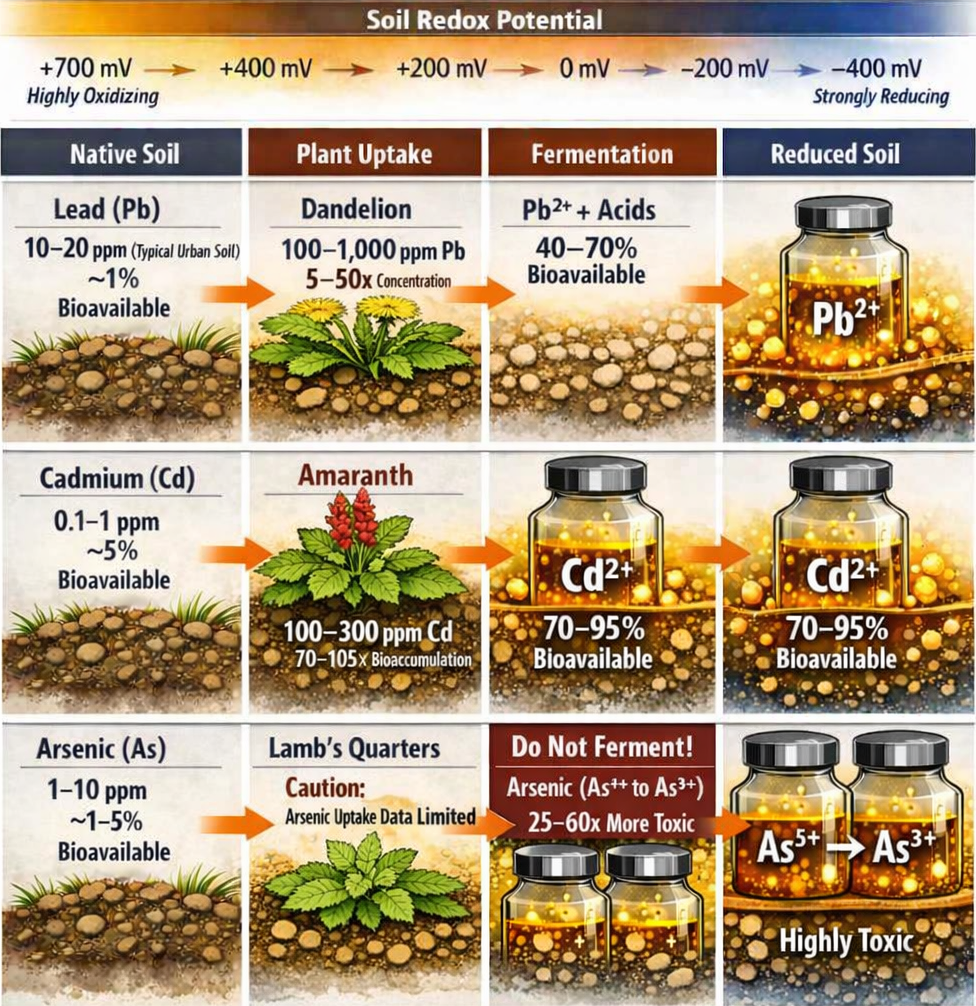
Background soil lead: 10–20 ppm (typical urban soil) → Dandelion tissue lead: 100–1,000 ppm (5–50× concentration) in typical urban and roadside contamination scenarios; exceeding 1,000 ppm documented at heavily contaminated industrial sites. (Source: Springer Environmental Science and Pollution Research, 2024)
Background soil cadmium: 0.1–1 ppm → Amaranth tissue cadmium: 100–300 ppm; bioaccumulation factors of 70–105× confirmed in controlled studies of Amaranthus hypochondriacus. (Source: MDPI Agronomy, 2023)
Background soil arsenic: 1–10 ppm → Chenopodium album (lamb's quarters) is documented as a cadmium and lead accumulator; peer-reviewed tissue arsenic concentration data for this species is insufficient to support specific figures. The primary documented arsenic hyperaccumulator relevant to garden settings is Pteris vittata (brake fern). Do not ferment any plant material from sites with known arsenic contamination.
When you ferment a bucket of these plants, you're creating a liquid that contains metals at concentrations 5 to 100 times higher than the original soil—and converting them into forms that are immediately bioavailable when applied. In the case of arsenic, the oxidation state change alone (arsenate to arsenite) multiplies effective toxicity by 25–60× independent of concentration.
Heavy Metal Chemistry: Specific Mechanisms and Thresholds
Understanding the precise chemical transformations that occur at different redox potentials is essential for assessing contamination risks. Each heavy metal follows distinct pathways as redox conditions change, and the toxicity differences can be orders of magnitude.
Arsenic: The Two-Step Mobilization Process
Arsenic contamination follows a particularly dangerous two-step process that makes it the most concerning metal in reducing environments:
Step 1: Physical Release via Iron Oxide Dissolution (+100 to +200 mV)
Arsenate (As⁵⁺) exists in aerobic soils primarily adsorbed to iron oxide minerals (ferrihydrite, goethite). These iron minerals act as 'prison walls' keeping arsenic immobile. When redox potential drops into the iron-reducing range (+100 to +200 mV), iron-reducing bacteria use Fe³⁺ as their electron acceptor:
Fe³⁺ + e⁻ → Fe²⁺ (soluble)
As iron oxides dissolve, arsenate adsorbed to their surfaces is released into soil solution. This creates the first contamination pulse—arsenate becomes mobile even before chemical transformation.
Step 2: Chemical Reduction to Arsenite (0 to +100 mV)
Once in solution, arsenate undergoes direct microbial and chemical reduction to arsenite:
AsO₄³⁻ + 2H⁺ + 2e⁻ → AsO₃³⁻ + H₂O
This transformation is critical because arsenite (As³⁺) is 25–60 times more toxic than arsenate (As⁵⁺) and far more bioavailable. Arsenite enters plant roots through the same channels as silica, which plants require in large quantities.
Quantified Risk: Soil arsenic that was 1–5% bioavailable as arsenate becomes 60–90% bioavailable as arsenite. A 10 ppm soil arsenic level delivers 0.1–0.5 ppm bioavailable arsenic under aerobic conditions, but 6–9 ppm bioavailable arsenic under reducing conditions.
Lead: Iron Oxide Co-precipitation and Sulfate Chemistry
Lead contamination follows an indirect but equally dangerous pathway controlled by the minerals that bind it:
Aerobic Binding Mechanisms (Above +200 mV)
Iron oxide adsorption: Pb²⁺ strongly adsorbs to ferrihydrite and goethite surfaces
Lead sulfate formation: PbSO₄ precipitates in sulfate-rich environments (highly insoluble)
Manganese oxide co-precipitation: Pb²⁺ incorporates into birnessite and pyrolusite structures
Mobilization During Iron Reduction (+100 to +200 mV)
The same iron oxide dissolution that releases arsenic also liberates co-precipitated lead. Lead doesn't change oxidation state, but its host minerals dissolve:
FeOOH·Pb²⁺ → Fe²⁺ + Pb²⁺ (both soluble)
Sulfate Reduction Effects (Below -100 mV)
Under extreme reducing conditions, sulfate-reducing bacteria consume sulfate, destabilizing lead sulfate:
SO₄²⁻ + 8H⁺ + 8e⁻ → S²⁻ + 4H₂O
This creates a complex situation: lead sulfate (PbSO₄) dissolves as sulfate is consumed, but lead sulfide (PbS) precipitates as sulfide is produced. The net effect depends on kinetics—there's typically a window of maximum lead solubility during the sulfate-to-sulfide transition.
Cadmium: The Most Redox-Sensitive Agricultural Contaminant
Cadmium exhibits the most straightforward and dangerous redox response of common agricultural contaminants:
Binding and Release Mechanism
Unlike arsenic and lead, cadmium doesn't form strong sulfide complexes until very low redox potentials. It remains in solution throughout most of the reducing sequence:
Above +200 mV: Cd²⁺ adsorbs to iron and manganese oxides, relatively immobile
+100 to +200 mV: Iron oxide dissolution releases cadmium to solution
0 to +100 mV: Cadmium remains freely available, competing with zinc for plant uptake
Below -150 mV: Cadmium sulfide (CdS) finally precipitates, partial re-immobilization
Agricultural Significance
Cadmium enters plants through zinc uptake channels, making it particularly dangerous in zinc-deficient soils. The reducing conditions that mobilize cadmium also tend to decrease zinc availability (through ZnS formation), creating a double exposure risk.
Bioaccumulation Warning: Cadmium in leafy vegetables grown on reduced soils can exceed WHO safety limits even when total soil cadmium appears acceptable. The bioavailability increase from redox mobilization is not captured in standard soil testing.
Chromium: The Oxidation Exception
Chromium behavior inverts the usual redox-danger relationship, making it critical to understand for complete risk assessment:
The Two Forms and Their Toxicity
Cr³⁺ (trivalent): Relatively insoluble, low toxicity, not carcinogenic at environmental levels
Cr⁶⁺ (hexavalent): Highly soluble, highly mobile, Group 1 human carcinogen
Manganese Oxide-Mediated Oxidation (Above +300 mV)
The dangerous transformation occurs under oxidizing conditions, mediated by manganese oxides:
Cr³⁺ + 1.5 MnO₂ + 3H⁺ → Cr⁶⁺ + 1.5 Mn²⁺ + 1.5 H₂O
This means that re-aeration of reduced, chromium-contaminated materials can generate Cr⁶⁺ pulses. Wet/dry cycling in contaminated soils creates repeated Cr⁶⁺ spikes at the aerobic/anaerobic interface.
Cycling Danger: Compost that went anaerobic (reducing Cr⁶⁺ to safe Cr³⁺) then re-aerates on application could release a carcinogenic Cr⁶⁺ pulse as manganese oxides re-form and oxidize chromium.
Mercury: Methylation and Biomagnification
Mercury transformations under reducing conditions create the most bioaccumulative toxin in environmental chemistry:
Sulfate-Reducing Bacteria Pathway (Below -100 mV)
Under extreme reducing conditions with active sulfate reduction, specialized bacteria convert inorganic mercury to methylmercury:
Hg²⁺ + CH₃⁻ → CH₃Hg⁺ (methylmercury)
Methylmercury is orders of magnitude more toxic than inorganic mercury and bioaccumulates through food chains. This reaction is essentially irreversible under environmental conditions.
Municipal Waste Contamination Source
Municipal green waste often contains mercury from broken fluorescent bulbs, electronics, and dental amalgam in sewage fractions. When this material is composted under reducing conditions, any mercury present becomes methylated.
Selenium: Four-Stage Redox Chemistry
Selenium demonstrates the most complex redox chemistry of any agricultural micronutrient, changing form four times across the redox spectrum:
Above +400 mV: Selenate (Se⁶⁺)
Very mobile, readily taken up by plants; optimal for micronutrient applications
+200 to +400 mV: Selenite (Se⁴⁺)
Moderate mobility, adsorbs to iron oxides; reduced efficacy of Se applications
0 to +200 mV: Elemental Se⁰
Precipitates as red metallic selenium, immobile; complete loss of bioavailability
Below 0 mV: Selenide (Se²⁻)
Forms metal selenides (FeSe, ZnSe), immobile; selenium deficiency despite adequate total Se
Manganese: The Redox Driver and Early Warning System
Manganese is unique because it both responds to redox conditions and actively drives redox chemistry in soil systems:
First Metal to Mobilize (+200 to +300 mV)
Manganese reduction occurs at higher redox potentials than iron, making it an early warning indicator:
MnO₂ + 4H⁺ + 2e⁻ → Mn²⁺ + 2H₂O
Manganese toxicity in plants is often the first visible symptom of waterlogged or poorly aerated soils. Brown leaf spots and interveinal chlorosis indicate reducing conditions are developing.
Manganese as Chromium Oxidizer
Manganese oxides are the primary agents that oxidize Cr³⁺ to carcinogenic Cr⁶⁺. When soils re-aerate and manganese oxides re-form, any chromium present becomes a carcinogenicity risk.
The Master Equation: Sequential Reduction Cascade
The complete sequence of electron acceptor utilization follows thermodynamic favorability:
Above +400 mV: O₂ → H₂O (Aerobic respiration) | Metals bound, Cr⁶⁺ formation
+200 mV: NO₃⁻ → N₂ (Denitrification) | Mn mobilization begins
+100 mV: Fe³⁺ → Fe²⁺ (Iron reduction) | As, Pb, Cd release
0 mV: AsO₄³⁻ → AsO₃³⁻ (Arsenate reduction) | Maximum As toxicity
-100 mV: SO₄²⁻ → S²⁻ (Sulfate reduction) | Hg methylation, metal sulfides
-200 mV: CO₂ → CH₄ (Methanogenesis) | Extreme conditions
Fermentation Chemistry: Fermentation drives redox potential to -200 to -400 mV, activating the most dangerous transformations in this sequence. Organic acids produced simultaneously chelate mobilized metals, creating a concentrated toxic delivery system.
The Chemistry Behind the Danger: From Plant Protector to Metal Mobilizer
What Hyperaccumulator Plants Actually Do
Hyperaccumulator plants—common weeds like dandelion, plantain, lamb's quarters, and amaranth—can concentrate heavy metals from soil at 100–1,000 times background levels. These plants survive this contamination through sophisticated protective mechanisms:
Cellular compartmentalization—metals stored in specialized organelles away from critical functions
Binding to protective organic molecules that limit toxicity
Sequestration in cell walls and vacuoles that act as isolation chambers
While alive, these plants function as biological vacuum cleaners—removing metals from soil solution and locking them away in plant tissue.
What Fermentation Does to These Protective Mechanisms
Fermentation systematically destroys every protective mechanism the plant used to safely store heavy metals:
Cell wall breakdown → Metal storage compartments rupture → Metals released into solution
Anaerobic conditions → Reducing chemistry (-200 to -400 mV) → Conversion to most toxic forms
Organic acid production → Acetic, lactic acids created → Powerful metal chelation
The Bioavailability Multiplication Effect
The combination of these processes creates a catastrophic increase in metal bioavailability:
Dissolved metals—no dissolution lag time, immediate uptake
Organic acid chelation—metals bound to mobile carriers that bypass plant defenses
Most toxic oxidation states—arsenate → arsenite (60x more toxic), Cr³⁺ → Cr⁶⁺ (carcinogenic)
Low pH—acid conditions that enhance metal mobility in soil
The Math: Soil contamination that was 1–5% bioavailable becomes 60–90% bioavailable after fermentation and application. You've multiplied exposure risk by 10–50x.
Case Studies: Common Misapplications We're Observing
Case Study 1: Misunderstood Natural Farming Techniques
Educational institutions have been documented applying fermented weed extracts to growing areas where children have direct contact, based on misinterpretations of traditional farming practices. These applications combine multiple dangerous misunderstandings:
Confusion of Korean Natural Farming techniques (which ferment vigorous plants to promote growth)
Misapplication of biodynamic 'plant preparation' concepts
Fundamental misunderstanding of allelopathy (natural plant competition chemicals)
In these documented cases, children working in treated garden areas were being exposed to concentrated heavy metals from fermented weed extracts through skin contact, inhalation of spray droplets, and hand-to-mouth transfer.
Case Study 2: 'Closed-Loop' Remediation Attempts
Urban growing operations have attempted to 'close the loop' on phytoremediation by fermenting hyperaccumulator plants and reapplying the liquid, believing this would continue the soil cleaning process. Documentation shows these practices result in:
Metals that had been successfully removed from soil being reintroduced in more dangerous forms
Contamination spreading from localized hotspots to distributed soil solution
Net contamination increase despite good intentions
These cases demonstrate how practices that appear logical and 'natural' can reverse remediation progress and create new exposure pathways.
The Fermentation Craze in Natural Farming
What I'm witnessing is part of a broader trend: fermentation is being introduced into natural farming as a universal solution. Social media is full of videos showing people fermenting everything—weeds, kitchen scraps, fallen fruit, garden waste—and applying the results as soil amendments, foliar feeds, and pest deterrents.
The appeal is obvious: fermentation feels ancient, natural, and transformative. It's cheap, accessible, and creates something that looks and smells "alive" with beneficial microorganisms.
But this one-size-fits-all approach to fermentation ignores fundamental principles:
Source material matters: What you ferment determines what you create
Contamination potential: Fermentation can mobilize toxins rather than neutralize them
Application context: A practice safe for one setting can be dangerous in another
Regulatory gaps: "Natural" doesn't mean "tested" or "safe"
The Korean Natural Farming and biodynamic traditions that inspire these practices developed in specific contexts with specific materials for specific purposes. When those techniques get generalized into "ferment anything and everything," we lose the wisdom that made them safe and effective.
The Exposure Pathway Nobody's Testing For
Here's what makes this particularly insidious: every existing safety test would have missed this.
California requires compost quality testing, but they test for total heavy metals—how much is there by weight. They don't test speciation—what chemical form the metals are in, which determines toxicity.
They don't test bioavailability—how much can actually be absorbed by living organisms.
And they certainly don't test for what happens when you ferment contaminated plant material into a concentrated toxic soup and spray it on children's play areas.
A soil or compost that passes every existing safety standard can still deliver a massive exposure pulse when applied as a fermented extract.
The Real Victims
Children working in these treated gardens have no idea they're being exposed to mobilized heavy metals through:
Skin absorption from handling contaminated soil
Inhalation of spray droplets and dust
Hand-to-mouth transfer (the primary exposure route for children)
Lead poisoning in children causes permanent cognitive damage. There's no safe level of exposure. Arsenic is a known carcinogen. Cadmium targets developing nervous systems.
These aren't theoretical risks. These are well-documented health impacts from compounds that were being delivered in their most toxic, most bioavailable forms.
Safe and Effective Alternatives
Proper Hyperaccumulator Plant Management
Harvest and remove contaminated plant material completely from the site
Dispose as hazardous waste or send to specialized metal recovery facilities
Never compost or ferment hyperaccumulator plants on-site
Test soil regularly to track remediation progress
Evidence-Based Weed Management
Dense plantings of desired crops to outcompete weeds
Organic mulching with clean, tested materials
Hand weeding with proper PPE
Cover crops to occupy the ecological niche
Safe Plant Extract Applications
If you want to use plant-based preparations:
Source plants from known-clean locations
Use vigorous, healthy plants (comfrey, nettle), not weeds
Test both source plants and extracts for heavy metals
Never apply untested extracts where children will have contact
Best Practice: In school and institutional gardens, restrict plant extract applications to products with verified heavy metal testing and established safety protocols.
Immediate Safety Protocols
If You've Applied Fermented Weed Extracts
Stop all applications immediately
Test soil for heavy metals in treated areas
Restrict access to treated areas until testing confirms safety
Document application history—when, where, what plant materials were used
Consult with soil testing professionals about remediation if contamination is confirmed
For Ongoing Garden Management
Establish testing protocols for any plant-based inputs
Source plant materials only from known-clean locations
Train all garden managers on heavy metal risks and hyperaccumulator plant identification
Implement the precautionary principle—when in doubt, don't apply
What You Can Do
If you're managing a garden:
Stop any applications of fermented plant material from unknown sources
Test your soil for heavy metals, especially in urban areas
Learn to identify hyperaccumulator plants
Question any practice that seems too good to be true
If you're a parent:
Ask garden managers what they're applying to growing areas
Request documentation for any plant-based treatments
Advocate for soil testing in school garden programs
Trust your instincts if something seems off
If you're an educator:
Implement formal safety protocols for all garden inputs
Train staff to recognize and safely handle hyperaccumulator plants
Require testing for any plant-based preparations
Document everything for liability protection
The Broader Pattern
This story isn't unique. Across the country, well-intentioned gardeners, educators, and small farmers are inadvertently creating heavy metal exposure risks through misunderstood "natural" practices.
The sustainable agriculture community's faith in "natural = safe" combined with incomplete information from internet sources is creating a pattern of dangerous practices that slip under every regulatory radar.
We need to do better.
The Bottom Line
The growers I encounter doing this are trying to do the right thing. They genuinely believe they're creating natural, beneficial treatments for their gardens. They're following advice they've found from sources they trust.
But good intentions and natural ingredients don't override chemistry and physics.
When we ferment hyperaccumulator plants and apply the liquid back to soil, we're not extending a cleaning process—we're reversing it. We're taking contamination that was safely sequestered and converting it into the most dangerous form possible.
In vulnerable population settings—schools, hospitals, anywhere children are present—this isn't just a mistake. It's a public health crisis waiting to happen.
The solution isn't to abandon plant-based growing practices. It's to understand them deeply enough to apply them safely.
Because in agriculture, as in medicine, first do no harm.
David King is Executive Director of ORCA (Organic Regenerative Certified Apprenticeship), a California state-certified and federally registered nonprofit apprenticeship program based in Comptche, Mendocino County. He operates Surprise Valley Agroecology, providing soil chemistry consulting using the Albrecht Method and microscope-based soil biology assessment. ORCA's work focuses on curriculum development and technical consultation for vulnerable population garden settings.
Key Resources
Heavy metals testing laboratories: Contact your state agricultural extension office for certified lab recommendations
Hyperaccumulator plant identification: USDA NRCS plant database includes accumulator species by region
School garden safety protocols: National Farm to School Network provides baseline safety guidelines
Emergency consultation: If you suspect heavy metal exposure in a children's program, contact your local environmental health department immediately
For technical consultation on soil chemistry and heavy metals testing: info@orca-ca.com