The Granges Are Still Standing
Why the Most Important Infrastructure for Rebuilding Rural America Is Already in Place
David King
3/7/202616 min read
The Granges Are Still Standing
Why the Most Important Infrastructure for Rebuilding Rural America Is Already in Place
David King · ORCA · Organic Regenerative Certified Apprenticeship · Comptche, Mendocino County, CA
"Nature as Principle, Methods as Tools"
Drive through the small farming communities of Mendocino County — Boonville, Philo, Laytonville, Willits, Ukiah, Manchester, Albion — and you will see them. Substantial wooden buildings, well-constructed, set at the center of what were once farming communities. Some are freshly painted. Some need work. A few have solar panels going up on the roof. Most are quiet on most days of the week.
These are Grange halls. There are seven of them in Mendocino County alone. They were not built by the government. They were not built by a corporation. They were built by farming families who pooled their labor and their money to create a physical space for something they understood to be essential: a place where people who worked the land could come together, share knowledge, organize, feed each other, and govern themselves.
They are still standing. And right now, at a moment when rural communities across California are being told they are an economic burden — too spread out, too expensive to service, too inefficient to justify — that fact matters enormously.
This is the story of what those buildings were built for, what happened to them, and why they are the most underutilized asset in the effort to rebuild rural economies. It is also a story about what ORCA is doing in their shadow — and what we believe they can become.
Part 1 — What the Grange Was Built to Do
The Original Problem: Farmers Were Alone and Being Robbed
The Patrons of Husbandry — universally known as the Grange — was founded in 1867 by Oliver Hudson Kelley, a Minnesota farmer and USDA clerk who had traveled the post-Civil War South and been appalled by the isolation, poverty, and vulnerability of American farming families. What Kelley saw was a class of people who produced the food that fed the country, who owned land and worked it skillfully, and who were being systematically exploited by every institution they depended on: railroads charging monopoly rates to move grain, grain elevator operators rigging the scales, banks lending at predatory rates to people with no alternative, and merchants marking up every input a farm required.
The farmer's problem was not lack of skill or lack of land. It was structural isolation. Each farming family was alone in its negotiation with every institution that extracted value from its labor. The railroad knew this. The grain elevator knew this. The bank knew this. And they priced accordingly.
Kelley's answer was the Grange: a decentralized, farmer-governed fraternal organization that would give rural people the one thing they lacked — each other. At its peak, the Grange had over 800,000 members operating in thousands of communities across 36 states. In thirty-six states and thousands of small communities, the Grangers built solid wooden meeting halls as a physical symbol and practical realization of community. In California, most counties had multiple halls. Most communities in Mendocino County had its Grange Hall.
What the Halls Were Actually Used For
The Grange hall was not a clubhouse. It was the functional civic infrastructure of a farming community. Understand what that meant in practice:
Agricultural education and knowledge exchange. Field days, demonstration workshops, and meetings where farmers shared what was working in their specific soils and specific climates. The nodule cut test, earthworm counts, soil texture assessments, seed trials — these were demonstrated by experienced farmers to newer ones, in the hall and in the surrounding fields, in exactly the peer-to-peer format that transmits embodied knowledge that cannot be learned from a bulletin.
Cooperative buying and selling. Grange cooperatives negotiated bulk purchasing of seed, equipment, and supplies, cutting out the markup that isolated farm families had no power to resist. They negotiated collective marketing arrangements that gave small farms the same leverage as large ones.
Political organizing. From the start they were considered radicals by the banker Republicans and railroad tycoons. Worse, they were an effective opposition to the monopolists. In their long history they pushed for and got the Cooperative Extension Service, Rural Free Delivery and the Farm Credit System. They made the small farmer heard in the halls of power. The Granger Laws of the 1870s — state legislation forcing railroads and grain elevators to charge fair rates — were a direct product of organized Grange political power.
Community social life. In rural communities where neighbors were miles apart and there was no other public gathering space, the Grange hall was where people got married, buried their dead, celebrated harvests, held elections, staged plays, danced, and simply sat together at a common table. For many farming communities across Mendocino County, it was the only room large enough to hold the whole community at once — and for generations it was the center of community life in a way that no church, no school, and no government building could replicate.
Women's full participation. From its founding, the Grange gave women equal standing as members — including voting rights within the organization, decades before women could vote in national elections. Women held the position of Worthy Master. This was not incidental. It reflected a recognition that farming is a whole-family enterprise, and that women carried as much of the knowledge as men.
Civic infrastructure that government didn't provide. The Grange founded the Valley Improvement Association in 1905 which promoted telephone service and a new electric railway. It initiated new public high school districts. It organized Good Roads Leagues. It started circulating libraries. In rural areas where government services were thin or absent, the Grange built them.
"It is hard for us today to realize the dreariness of farm life a century ago. Visits to the market were few and neighbors were often miles apart. Into this dull life of the farmer and his family the Grange brought social contacts, news of the outside world, and the pleasure of laughing, talking and eating with new and old friends. Programs were an established item in the order of business and people who had never spoken, sung, or debated before an audience could now have that opportunity and experience." — Grange historian Inez Butz
The Grange as Knowledge Transmission Infrastructure
The Grange had no research budget for industry to capture, no government mandate to redirect, no professional credentialing system for corporate language to infiltrate. It was structurally immune to every mechanism that subsequently dismantled biological soil literacy from the Land Grant university system. And because it was immune to those mechanisms, it had to be emptied through a different one: the removal of the constituency it served.
Part 2 — What Happened to Them
The 1962 Watershed
The Committee for Economic Development — a private organization of corporate executives representing Standard Oil, major chemical companies, and the emerging pesticide and synthetic fertilizer manufacturers — issued its report An Adaptive Program for Agriculture in 1962. The report called explicitly for the elimination of approximately two million small farm operations over five years. It recommended consolidation, mechanization, and the replacement of diverse family farm operations with large commodity monocultures entirely dependent on purchased inputs.
The CED report did not mention the Grange. It did not need to. It targeted the class of people who used it. When two million small farm operations were eliminated over five years through coordinated policy — price supports structured to favor large operations, credit systems that rewarded consolidation, Land Grant universities reoriented toward input-optimization research — the constituency that filled the Grange halls simply ceased to exist at the scale required to sustain them.
The halls did not close dramatically. There was no announcement, no policy targeting them, no federal program to shutter them. They gradually, quietly emptied. The families who had built them, maintained them, and gathered in them on Friday nights for sixty years moved to town, or their children did, because the economic logic of small farming had been systematically dismantled around them. The knowledge those halls had transmitted — biological, agricultural, civic — went with them.
The Grange halls of Mendocino County are the most visible physical evidence of what we call the Great Forgetfulness — the systematic dismantling of agricultural biological literacy between 1962 and 1985. They are not abandoned because the knowledge they carried became obsolete. They are abandoned because the policy of 1962 eliminated the class of people who carried it.
What Was Left
The buildings survived because the Grange's legal structure protected them. The title to Grange buildings is listed in the name of the local Grange — maintained by Grangers, used by the community as a Grange Hall, just like has been done for a hundred years. No individual owner could sell them out from under the community. No developer could acquire them in a consolidation. They remained in community hands by legal structure even as the community that built them thinned out.
Some halls stayed active through the decades of decline — hosting weddings and community dinners and local meetings — operating at a fraction of their original capacity but never fully dark. The community depends on these halls for getting together and entertaining our communities as we do so well in our rural county. The buildings held on. And then, starting around 2012, something began to shift.
Part 3 — The Seven Halls of Mendocino County Today
There are seven active Grange halls in Mendocino County. Each one is a story of a specific community that built it, nearly lost it, and is now deciding what to do with it.
Anderson Valley Grange No. 669 — PhiloMonthly pancake breakfasts drawing 100+ community members. Annual seed and scion exchanges using Mendocino Grain Project flour. One of the most active halls in the county.
Fort Bragg Grange No. 672 — InglenookOriginally a one-room schoolhouse, a few miles north of Fort Bragg on Hwy 1. Reclaimed through litigation in 2020 after a seven-year dispute. Monthly breakfasts and seed sharing events.
Garcia Grange No. 676 — ManchesterServing the Garcia River farming corridor on the south Mendocino coast. The last of the seven halls returned to the National Grange in December 2020, completing the county's full restoration.
Little Lake Grange No. 670 — WillitsLovingly rehabbed by members with solar panels now on the roof. Home to the Inland Mendocino Farmers Guild monthly meetings. A working model of rural institutional sustainability.
Redwood Valley Grange No. 382 — UkiahA 100-year legacy building serving the Ukiah Valley. Navigated the California Grange disputes of the 2010s and emerged intact. One of the county's anchor agricultural communities.
Whitesboro Grange No. 766 — AlbionServing the Navarro Ridge farming community near Albion on the Mendocino coast. The surrounding landscape still carries the agricultural heritage the hall was built to support.
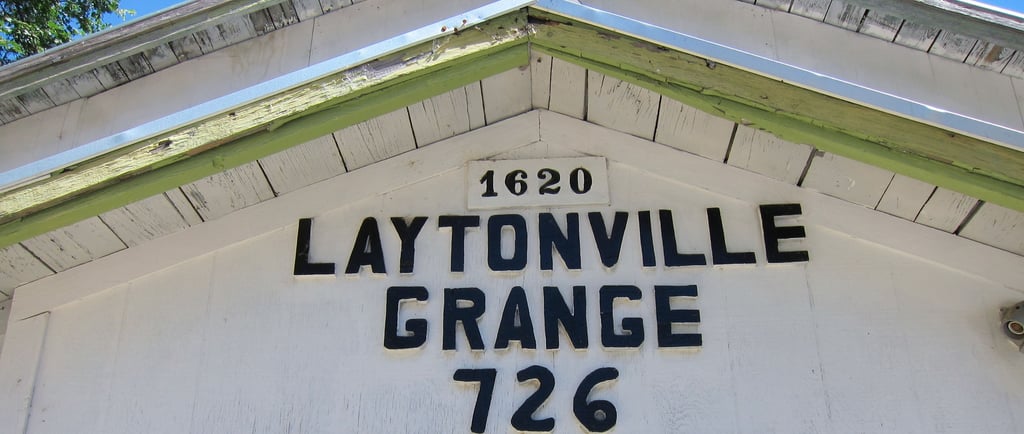
Laytonville Grange No. 726 — LaytonvilleServing the Cahto Valley and the county's northern inland farming communities. Laytonville has retained a strong agricultural identity through decades of rural decline — and the Grange has been part of why.
Together these seven halls represent a county-wide network of community-owned, legally protected, already-constructed gathering spaces distributed across the farming communities of Mendocino County. No government program built this. No corporation owns it. It was built by farming families and it belongs to farming communities. That is an asset of extraordinary value — and it is largely sitting idle.
There are seven community Granges in Mendocino County. Many Granges are modernizing their halls to be emergency shelters. Members can get discounts on propane and attend practical workshops — CPR training, ham radio operation, gravel installation. Mendocino County Grangers even started a retirement facility that houses 170 people. The infrastructure is already serving the community. The question is how much further it can go.
The Statewide Revival
In 2012, in what must have been an unimaginably distant future to our farmer ancestors, local Granges started acting up. In California, organized opposition to genetically modified crops came first from a Granger. Bob McFarland was elected state Grange president in 2009. As state president he organized a ballot initiative, Proposition 37, which would have mandated the labeling of GMOs in California. That got the Grange noticed.
Jini Reynolds, a Grange advocate and leader who is now president of the Pomona — the regional Grange serving Mendocino and Lake Counties — sees across the nation people asking, "How do we live sustainably?" The Grange's core idea is more relevant now than it has been in decades.
What is being rediscovered is not nostalgia. It is function. The problems the Grange was built to solve — structural isolation of small producers, extraction by concentrated interests, erosion of community knowledge and civic life — have not gone away. In many respects they have intensified. The infrastructure built to address them is still standing.
Part 4 — Why the Granges Matter for Rebuilding Rural Economies
The Infrastructure Problem That Isn't a Problem
Every serious effort to rebuild rural food economies runs into the same wall: infrastructure. Where do small producers process value-added products? Where do they cold-store perishables? Where do local food hubs aggregate supply for institutional buyers? Where do new farmers get trained? Where does the community gather to organize, plan, and govern itself?
These questions are typically answered with a grant application for a new building that takes five years to fund and ten years to build. The Grange answers them with a building that already exists, already belongs to the community, is already distributed across the county's farming communities, and already has the legal structure to serve as a community institution.
The seven halls of Mendocino County are not just meeting rooms. They are the physical nodes of a potential county-wide food system infrastructure network. Consider what each hall could anchor:
Local food aggregation and distribution hubs. Small farms producing diversified crops need a place to consolidate supply for institutional buyers — schools, hospitals, food banks, restaurants. A Grange hall is the right size, in the right location, with the right community ownership structure to serve this function.
Shared value-added processing facilities. A licensed commercial kitchen shared among ten small producers is economically viable where a private kitchen is not. The Grange hall — already constructed, already community-owned, already in the farming community — is the natural home for this infrastructure.
Curriculum delivery hubs. ORCA's core work is building rigorous, field-tested curriculum — developed through the apprenticeship program and then adapted for every farming sector: farm-to-school, market gardeners, home gardeners, tribal communities, hospital and correctional gardens. Grange halls are natural anchor points for delivering that curriculum across the county, reaching farmers where they already gather rather than asking them to come to an institution.
Cooperative buying power. The original Grange function — negotiating collective purchasing of inputs, equipment, and supplies — is as relevant today as it was in 1880. A network of seven halls representing farming communities across the county is the right structure for a county-wide agricultural cooperative.
Emergency resilience infrastructure. California's fire, flood, and grid failure reality makes community resilience infrastructure not optional but essential. Several Mendocino Granges are already being modernized as emergency shelters with solar, communication equipment, and water storage. A county-wide Grange network is a county-wide resilience grid.
Seed libraries and varietal preservation. The Anderson Valley Grange already hosts one of the county's most active seed and scion exchange programs. This function — preserving the genetic diversity of locally adapted crops — is exactly what a distributed community institution is designed to do.
The Circular Economy Argument
There is an argument being made in planning offices across California — and we have heard it directly — that rural communities are a fiscal burden: too spread out, too expensive to service, generating too little tax revenue to justify the infrastructure costs of roads, utilities, and emergency services. The argument is being used to discourage rural residential development and accelerate the consolidation of rural populations into urban centers.
This argument is not just wrong. It is measuring the wrong things. What it counts: the cost of a road. What it does not count: the farm at the end of the road, the tourists who drove that road to reach it, the value-added product processed in the town cooperative kitchen that the farm supplies, the hardware store that sells the farmer equipment, the school that doesn't need a free lunch program because the farming family is food-secure. A productive rural community is not a burden on the urban economy. It is a supplier, a customer, and a stabilizer of the regional food system. The Grange network is the institutional infrastructure for making that argument visible — and then making it real through organized economic activity.
Every dollar of farm revenue generates $1.50 to $2.00 in total local economic activity through downstream spending — on inputs, equipment, labor, processing, and services. The cost-of-services framework counts the road. It doesn't count the farm stand at the end of the road, the tourists who drove it, the co-op kitchen that processes what the farm produces, or the Medi-Cal enrollment that doesn't happen because the farming family is self-sufficient. The arithmetic is designed to find a burden. A complete accounting finds an asset.
The Knowledge Recovery Function
The most important thing the Grange can do right now is the same thing it did in 1880: serve as the transmission infrastructure for agricultural biological knowledge. The knowledge that was lost in the Great Forgetfulness — the soil biology, the plant diagnostics, the integration of livestock and soil management, the sensory assessment skills — cannot be recovered from a bulletin or a YouTube video. It requires demonstration and supervised practice by experienced practitioners. It requires the kind of peer-to-peer, field-based transmission that the Grange was built to provide.
ORCA's curriculum is designed to reconstruct exactly this knowledge base — developed through the apprenticeship program, then adapted and deployed across every farming sector the Grange halls serve. The seven halls of Mendocino County are the natural distribution network: not as formal classrooms, but as community gathering points where farmers meet farmers and where the knowledge lives in the hands and eyes of the people gathered, not in a document that no one knows how to read in the field.
The Recovery Lineage: Winogradsky → Waksman → Albrecht → Pfeiffer → Voisin → Luebkes → ORCA → Mendocino County Grange Network
Part 5 — The Grange as a Model for Rural Rebuilding
What Makes the Grange Structurally Different
There are many organizations working on rural food systems, regenerative agriculture, and community resilience. Most of them are externally funded, staff-dependent, and institutionally vulnerable to the same mechanisms that dismantled the Land Grant biological literacy they are trying to restore. The Grange is structurally different in ways that matter:
Community ownership — not institutional ownership
The buildings belong to the local Grange — meaning the farming families who built them. No outside funder, no state agency, no corporation can redirect or capture the asset. This is the legal structure that made the halls survive the last sixty years of rural decline. It is the same structure that makes them immune to the funding capture mechanisms that have undermined so many other agricultural institutions.
Geographic distribution — not centralization
Seven halls distributed across a county's farming communities is not a hub-and-spoke model with a central point of failure. It is a network. Each hall serves its specific community and its specific soils. Knowledge generated at the Anderson Valley Grange about Navarro watershed soils has immediate relevance to the farmers in that hall. This is how biological knowledge has always moved best — locally, specifically, in direct reference to the conditions at hand.
Non-partisan, non-ideological governance
The Grange's founding motto — "In essentials, unity; in non-essentials, liberty; in all things, charity" — is not merely decorative. It is a governance principle that has allowed the organization to unite farming communities across political differences for 150 years. A rural food system rebuilt on Grange infrastructure is not a liberal project or a conservative project. It is a farming community project. That political neutrality is a structural asset in a polarized moment.
Proven resilience across crises
The Grange has survived the Great Depression, two World Wars, the farm consolidation of the 1960s–1980s, the internal organizational conflicts of the 2010s, and a century of rural demographic decline. The halls are still standing because the community structure that owns them has the legal and social durability to outlast individual crises. This is not a startup. It is infrastructure with 150 years of stress-testing behind it.
What the Grange Movement Looks Like When It Works Today
The Anderson Valley Grange in Philo is the clearest current example of what a revived Grange can do. Every month, the Anderson Valley Grange holds a pancake breakfast at their Grange hall in the town of Philo. A team of volunteers prepares pancakes, eggs and bacon for the 100 or so community members who show up. The batter includes flour from the Mendocino Grain Project. The beer is from Anderson Valley Brewing. This is not a charity event. It is a local circular economy operating at the breakfast table: local grain, local brewing, local hall, local community — every dollar staying in the valley.
The annual seed and scion exchange at the same hall — tables covered with grafting material, seeds, and the county library's seed banks — is the Grange's original knowledge-transmission function in its most direct contemporary form. Farmers and gardeners exchanging locally adapted genetic material, peer to peer, in the hall their community built. No Land Grant needed. No extension specialist required. The knowledge moves through the room the same way it always did.
The Little Lake Grange in Willits, with solar panels going up on the roof, is demonstrating what the next generation of Grange infrastructure looks like: community-owned energy production, emergency resilience capability, and the organizational infrastructure to host the practical workshops — CPR, communications, soil assessment, seed saving — that a rural community needs and that no government program will reliably provide.
Section 6 — What ORCA Sees in the Grange Network
ORCA's core work is curriculum — rigorous, field-tested, soil-grounded agricultural knowledge built through the apprenticeship program and then adapted for every sector of farming: farm-to-school programs, market gardeners, home gardeners, tribal communities, hospital and correctional gardens. The apprenticeship is the tool that generates and validates that curriculum. The curriculum is what gets deployed. The long-term aim is for ORCA to serve as a trusted source of practical agricultural knowledge for educators and practitioners across every farming context — a support organization, not an institution trying to replace the farmer's own judgment.
The Grange network and the ORCA curriculum are natural partners — not because we share a formal organizational relationship, but because we share a structural logic: knowledge belongs to the people who work the land, and the job of any good agricultural organization is to support that work, not to capture it.
What we see in the seven halls of Mendocino County is a county-wide network of community-owned gathering spaces, each embedded in a specific farming community, each carrying a 100-year legacy of practical knowledge transmission. What ORCA is building is curriculum designed to live in exactly those spaces — adapted for the farmer, the school gardener, the market grower, the home gardener — and a nonprofit structure meant to support all of them, without institutional strings attached.
The knowledge that was lost in the Great Forgetfulness did not disappear entirely. It retreated to exactly the places where the institutional mechanisms of the 1960s–1980s could not reach it: practitioner communities, alternative agricultural networks, and the Grange halls themselves, where the culture of practical, peer-to-peer agricultural knowledge never fully died.
What we are doing is not starting something new. We are reconnecting something old.
The Grange halls of Mendocino County were built by farming families who understood that isolation is the farmer's greatest vulnerability. ORCA exists for the same reason — not to be another institution telling farmers what to do, but to support them with the best available knowledge, in whatever form their work takes, from the school garden to the market farm to the homestead. You cannot build a food system from a grant application. You build it community by community, season by season, until the knowledge is alive again in the hands of the people who work the land.
What You Can Do
If you live in Mendocino County, find your Grange hall. Attend a meeting. Bring food. Bring seeds. Bring a question about your soil. The people who have maintained those buildings through decades of rural decline are not waiting for permission to rebuild. They are waiting for community.
If you are a farmer, market gardener, or agricultural practitioner anywhere in Northern California, the Grange model is replicable. Across the nation, people are asking how to live sustainably. The Grange has been asking and answering that question for 150 years. The halls are standing in your county too.
If you are a policy maker, investor, or funder looking at rural economic development, understand what you are looking at when you see a Grange hall: 150 years of community investment in locally governed, legally protected, geographically distributed civic infrastructure. The cost to build this from scratch would be enormous. The cost to activate what already exists is a fraction of that — and the returns, in food system resilience, community stability, and rural economic vitality, are documented across 150 years of American agricultural history.
The buildings are still standing. The question is whether we have the will to fill them again.
ORCA · Organic Regenerative Certified Apprenticeship · Surprise Valley Agroecology LLC · Comptche, Mendocino County, CA
"Nature as Principle, Methods as Tools" ·