The Fat of the Land: Why the Health of Your Soil Decides What Reaches Your Immune System
What's living in your soil determines what reaches your immune system. Here's the chain — and why modern agriculture broke every link in it.
David King
7/2/202614 min read
The Fat of the Land: Why the Health of Your Soil Decides What Reaches Your Immune System
A field guide to the hidden chain connecting living soil, the lymphatic immune system, and human health
Every farmer, every nutritionist, and every physician is working inside the same biological system — one that doesn't begin in a laboratory, a pharmacy, or a kitchen. It begins in the soil.
There's a story buried in the science of soil biology, plant physiology, and human digestion that almost nobody tells as a single, continuous chain. It's a story about fat — specifically about a class of molecules called lipids — and how they travel from a living, breathing community of soil microorganisms, through a plant's cell walls and pigment-storing structures, into your small intestine, and finally into your body's immune system. When that chain is intact, your body receives what the soil set in motion. When it's broken — and in modern agriculture and modern diets, it usually is — the nutrition on paper and the nutrition that actually reaches your tissue can be two very different numbers.
This is that story. Some of it is established, peer-reviewed science. Some of it is an original hypothesis connecting the established dots into a single picture nobody has yet measured end to end. Both are worth understanding, and we'll be clear about which is which.
Fat Is Not One Thing
When most people hear "fat," they think of one undifferentiated substance to be minimized or avoided. But fat — the scientific term is lipid — is a large family of molecules with very different jobs.
Short and medium-chain fatty acids, the kind found in coconut oil, are small and quick. They're absorbed directly into the bloodstream and used mostly for fast energy.
Long-chain fatty acids are a different story entirely, and they're the center of this one. These are larger molecules — carbon chains sixteen to twenty-two atoms long — found in olive oil, fish, flaxseed, and most plant oils. Unlike their short-chain cousins, long-chain fats are not absorbed directly into the blood. The intestine packages them into specialized transport vehicles called chylomicrons, which enter the lymphatic system — the body's immune and transport network — and travel through it before ever reaching the bloodstream. This detour matters enormously, because it means long-chain fats and everything traveling with them bypass the liver's first-pass filtering and go straight into immune tissue.
Then there are very-long-chain fatty acids, twenty-four carbons and longer, which don't get eaten at all in the usual sense. These form the waxy, protective surfaces of plant cell walls, fruit skins, and trichomes — the tiny structures on a cannabis flower. In the soil, fungi are the primary producers of this category, and they become part of the architecture of the entire soil food web.
It Starts With What's Living Underground
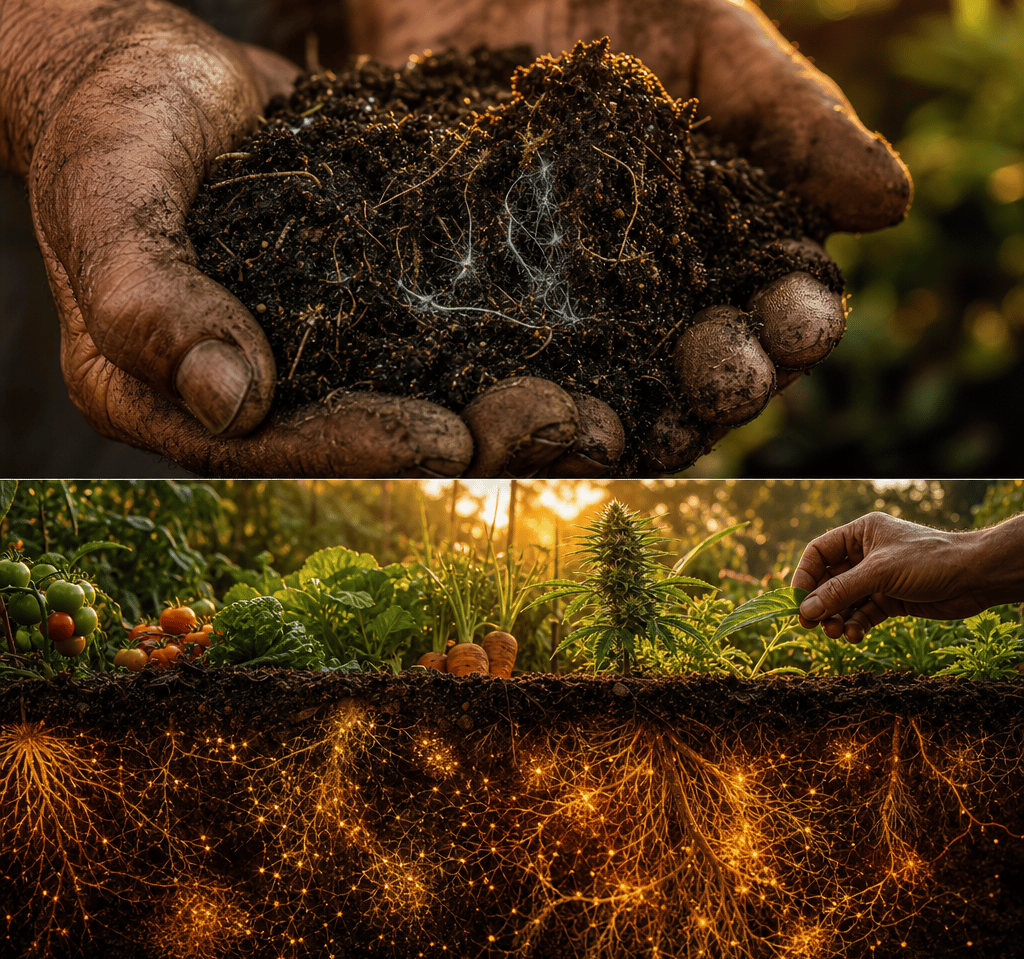
Soil is not an inert growing medium. It's a community — bacteria, fungi, protozoa, nematodes, microscopic arthropods — locked in a continuous cycle of living, dying, and transforming. When those organisms die, their cell membranes, built from long-chain fatty acids, don't simply vanish. They remain in the soil as intact molecular structures, becoming one of the primary sources of plant-available lipids in a healthy soil profile.
Fungi add an entire additional layer. Mycorrhizal fungi — the underground networks that connect directly to plant roots — produce very-long-chain fatty acids and wax compounds in abundance as they extend through the soil. The result, in healthy biologically active soil, is what soil scientists call a dynamic living lipid economy. This is not a reservoir of free-floating fat — phospholipids in dead cells break down rapidly in soil. What PLFA actually measures is the phospholipids inside the membranes of living microbes at the moment of the test. High PLFA means a large, active, living microbial biomass. It is the continuous turnover of that living community — and its active symbiotic exchanges with plant roots through mycorrhizal transfer and the rhizophagy cycle — that keeps the plant supplied with a continuous flow of fresh, pre-built lipids. The biology doesn't store the fat. It manufactures and delivers it, continuously, as long as the community is alive and functioning.
Depleted soil — farmed year after year with synthetic inputs, stripped of organic matter, managed without attention to biology — tells the opposite story. Its PLFA content collapses. The lipid economy of the soil effectively shuts down. And as this story will show, that shutdown has consequences that travel all the way to the human bloodstream.
The Plant Doesn't Have to Build Everything From Scratch
Plants need long-chain fatty acids constantly — to build cell membranes, the protective waxy cuticle on their leaves, and the internal architecture of the organelles that store their pigments and protective compounds. Building these molecules from raw carbon is metabolically expensive. Synthesizing a single molecule of a common 16-carbon fatty acid from scratch costs a plant roughly fourteen percent of its total photosynthate — the sugar energy harvested from sunlight. That's a significant operating expense for a plant running its own internal fat factory.
But a plant rooted in biologically active soil doesn't have to run that factory alone. Two distinct, well-documented mechanisms deliver pre-built fatty acids directly to the root.
The first is called the rhizophagy cycle, documented by researchers at Rutgers University. Root cells actively engulf living soil microorganisms, strip the long-chain fatty acids directly from their membranes, absorb those fats, and then release the microbes back into the soil unharmed. The plant harvests fat from the soil community without destroying it.
The second is mycorrhizal transfer. Arbuscular mycorrhizal fungi grow directly into root cells and hand over long-chain fatty acids — specifically palmitic and oleic acid — at the point of contact, confirmed in landmark studies published in Science and eLife in 2017. The plant pays in sugar. The fungi pay in fat. But there's a deeper layer here worth understanding: the P in PLFA stands for phosphorus. Phospholipids — the building blocks of every cell membrane in the chain — are phosphorus compounds. And ATP, the energy currency that powers every metabolic step the plant takes, is entirely phosphate-dependent. Mycorrhizal fungi are also the primary mobilizers of soil phosphorus, reaching mineral phosphorus that roots alone cannot access. This means the fungi aren't just delivering pre-built lipids — they're delivering the phosphorus the plant needs to build its own phospholipids and run the metabolic engine that powers the entire quality cascade.
When a plant receives pre-built fatty acids instead of manufacturing them from scratch, the energy it saves doesn't disappear. The evidence suggests it is redirected — most importantly, into secondary metabolism: the production of terpenes, cannabinoids, carotenoids, and the other complex compounds responsible for flavor, color, aroma, and medicinal value. This is the central agronomic inference buried in all of this: a plant supported by a living soil lipid economy may run more efficiently, spending less energy on basic manufacturing and more on the complex chemistry that makes food nutritious and medicine effective. The quality gap between food grown in living soil and food grown in depleted soil isn't primarily about which inputs were applied. It appears to be a difference in metabolic efficiency, driven from underground — though the direct quantification of this effect across soil types and crops remains an important frontier.
What the Plant Builds With That Fat
The fatty acids a plant receives from soil biology get used to build three structures that matter directly for human health.
The first is the cell membrane itself — every cell in the plant, from leaf to root to fruit, is wrapped in a fat-based membrane whose thickness and integrity determine the plant's structural strength and its ability to regulate water and nutrients. A plant with abundant lipid precursors builds thicker, denser membranes, visible in the field as a thick, waxy leaf with real cuticle sheen.
The second is the chromoplast — the organelle responsible for storing carotenoids, the orange, red, and yellow pigments in fruits and vegetables. This is where the story gets genuinely surprising. Whether a carotenoid ends up stored as a dry crystal — as it is in a raw carrot — or dissolved in a lipid, liquid-crystalline form — as it is in a ripe papaya — depends directly on the lipid content of the chromoplast membrane. And the difference in human absorption between those two physical forms is enormous. A raw carrot delivers roughly half a percent of its beta-carotene to your bloodstream. Papaya delivers more than ten times that. The carotenoid is chemically identical. The packaging is not.
The third structure is the surface wax — the very-long-chain fatty acid layer that coats fruit skin, leaf surfaces, and, in cannabis, the head of the trichome. This wax layer is a sealed biological vessel, protecting whatever compound it surrounds from oxidation, moisture, and microbial degradation. It is the plant's own preservation technology, built entirely from the fat the soil provided.
The Human Side: What Happens When You Eat
When you eat a vegetable, you aren't consuming nutrients floating in isolation. You're consuming them embedded inside molecular architecture — cell membranes, chromoplasts, wax layers — that the plant assembled from whatever lipid substrate it had access to during growth. Whether those fat-soluble compounds actually make it into your body depends on two things: whether that plant architecture was built well, and whether you provide your intestine with the dietary fat it needs to complete the delivery.
Here's the mechanism. In your small intestine, long-chain fatty acids from your meal are emulsified by bile salts into tiny structures called mixed micelles. Fat-soluble compounds — carotenoids, fat-soluble vitamins, cannabinoids, curcumin, CoQ10 — can only cross into the intestinal wall by hitching a ride on these micelles. No micelle, no entry. The intestinal wall cell then repackages everything into chylomicrons and releases them into the lymphatic capillaries of the gut, where they travel through the lymphatic system — entirely bypassing the liver — before finally entering the bloodstream near the heart.
This isn't just an alternate delivery route. It's a delivery route that runs directly through your immune tissue, delivering compounds at concentrations the standard blood-and-liver pathway simply cannot achieve.
The Fat-Free Catastrophe
Here's the part of this story that should change how you think about salad dressing.
Researchers at Iowa State University, in a study from 2004 later confirmed multiple times, fed people a salad of spinach, romaine, carrots, and tomatoes with fat-free dressing. The carotenoids in that salad — beta-carotene, lutein, lycopene — showed up in blood chylomicrons at negligible levels. Not reduced. Negligible. The same salad eaten with full-fat olive oil dressing delivered those same compounds efficiently. Adding avocado to the salad raised beta-carotene absorption fifteen-fold and lutein absorption five-fold.
The vegetables hadn't changed. The carotenoids inside them hadn't changed. The only variable was whether long-chain fat was present at the same meal — the raw material the intestine needs to build the chylomicron delivery vehicle in the first place. Without it, the system simply doesn't switch on.
Three decades of low-fat dietary advice told people to eat more vegetables while cutting back on fat. For the specific compounds most associated with cancer prevention, eye health, and immune function, this turns out to be close to the worst possible combination. To be precise about the limits of this finding: fiber, water-soluble vitamins, and minerals in those vegetables are unaffected by the presence of fat. But the fat-soluble protective compounds — the ones much of the public health case for eating vegetables rests on — require dietary fat to be absorbed at all. That's not a minor footnote. It's a fundamental reframing of what a healthy meal needs to include.
Why Healthy Soil Means Fewer Sprays
The lipid story doesn't start with human nutrition, and for farmers, it doesn't end there either. It starts with whether the crop gets sick in the first place.
When the soil lipid cycle is functioning, the plant saves the metabolic energy it would have spent manufacturing fat from scratch. A meaningful share of that saved energy goes into completing the plant's primary metabolic processing — turning simple soluble nitrogen and sugar into complex proteins and dense, structural tissue. When that conversion runs to completion, the plant's sap becomes biochemically complex. And a plant with complex sap is, in a very literal sense, not digestible by the things that want to eat it.
This principle has a name: trophobiosis, first systematically documented by French agronomist Francis Chaboussou during five decades of research at INRA and published in 1985. Stated plainly: a pest starves on a healthy plant. Insects and fungal pathogens need specific nutritional substrates — simple amino acids and reducing sugars — that accumulate in the sap of a plant running an inefficient, incomplete metabolism. A plant running its metabolism fully processes those substrates into complex tissue the pest simply can't use.
When Chaboussou first published, the mechanisms he was describing weren't fully understood at the molecular level, and the theory met resistance from mainstream plant pathology. That has changed. A 2021 paper in Frontiers in Sustainable Food Systems directly engaged the trophobiosis mechanism using modern molecular language, documenting that nitrogen fertilisation increases free amino acids and reducing sugars in plant tissue faster than the plant can incorporate them into proteins — and that these soluble compounds are precisely the growth-limiting nutrients pests and pathogens require to proliferate. Multiple independent studies across potato, citrus, wheat, and rye have confirmed the same relationship: excess soluble nitrogen accumulates as free amino acids in plant tissue, and those amino acids correlate with increased susceptibility. The name trophobiosis remains outside mainstream plant pathology textbooks. The mechanism it describes is now documented in the peer-reviewed molecular literature.
The long-chain fatty acids supplied by soil biology are a direct part of this defense. They build thick cell walls and a dense waxy cuticle — a physical barrier that's harder for sucking insects and fungal hyphae to penetrate. These aren't chemical defenses sprayed on after the fact. They're structural defenses, built from the fat and minerals the soil supplied in the first place.
Modern conventional fertility programs can break this system at both ends simultaneously. High-salt, chloride-containing fertilizers — particularly potassium chloride, known as muriate of potash and one of the most widely used potassium sources in agriculture — dehydrate soil microbes and rupture their delicate lipid membranes, collapsing the PLFA biomass that drives the entire lipid economy. At the same time, high soluble nitrogen floods the plant with unprocessed free amino acids and reducing sugars faster than it can incorporate them into proteins — directly producing the simple sap chemistry that pests and pathogens require. The spray program that follows is not bad luck. It is a predictable biological consequence of inputs that simultaneously destroyed the soil's lipid-producing community and created the nutritional conditions pests need to thrive.
Growers tracking this in the field consistently report the same trajectory: spray applications drop thirty to fifty percent in years two and three of building soil biology, and approach zero by years four and five, as the plant's own defenses take over the job that chemistry used to do. Every fungicide and insecticide application is, in the end, a symptom response — treating the consequence of a plant that was already vulnerable before the first pest arrived. Investment in soil biology is front-loaded, and the input savings compound every year after.
The Chain Reaches Further Than Most People Realize
The same lipid-delivery logic that applies to a carrot's beta-carotene applies just as directly to supplements and to medicine.
Most vitamins and nutraceuticals on the market are formulated around the bloodstream-and-liver pathway, not the lymphatic one — and many of them would work dramatically better if that changed. Curcumin taken as a dry powder capsule has less than one percent oral bioavailability; the liver destroys nearly all of it before it can act. The same curcumin, cooked in oil the way it's traditionally prepared in Indian cuisine, travels the lymphatic route and reaches meaningful concentrations in immune tissue. Crystalline CoQ10 dissolves poorly in the gut and can lose up to seventy-five percent of its potential bioavailability to poor formulation; the same compound dissolved in long-chain triglyceride oil activates the chylomicron pathway properly.
Cannabis is one of the most instructive examples of this principle — and the most overlooked. A 2017 study published in Scientific Reports by Zgair and colleagues found that when CBD and THC were administered orally with lipids, CBD concentrations in the intestinal lymph reached 250 times the concentration measured in plasma. THC reached 100 times the plasma level. The same dose. The same compounds. The only difference was the presence of long-chain fat, which activated the chylomicron pathway and sent the cannabinoids directly into the lymphatic immune system rather than the liver-first portal route.
This explains something that practitioners using whole-plant cannabis preparations — particularly RSO (Rick Simpson Oil) and what the industry now calls full-extract cannabis oil, or FECO — have been observing for years: patients frequently report significantly stronger effects from whole-plant extracts than from refined isolates or distillates at equivalent cannabinoid doses. The conventional explanation offered is the entourage effect — the synergistic interaction of cannabinoids, terpenes, and other plant compounds. That is real. But it is only part of the story.
The other part is the lipid matrix. RSO and FECO are prepared to retain the full plant chemistry, including the plant's native long-chain fatty acids and phospholipids — the same fat-based context in which the plant stored its cannabinoids. When that native lipid matrix is present, the intestine has the substrate it needs to build chylomicrons and send the cannabinoids through the lymphatic route. When an extract is winterized — chilled and filtered to remove waxes and fats for a "cleaner" product — those lipids are precisely what gets stripped out. The cannabinoids remain. The delivery vehicle is gone. Some manufacturers reformulate with lipid carriers after winterization, which can partially compensate — but the native phospholipid complexity of the whole plant, which the 2021 sesame oil study suggests matters beyond simple fat quantity, is not restored by adding a purified triglyceride back in.
A 2021 follow-up study from the same research group added a further nuance: natural sesame oil outperformed purified triglycerides and pre-digested lipid formulations in promoting cannabinoid lymphatic transport. The whole, intact natural oil — with its full complement of fatty acid species — worked better than engineered fat fractions. The parallel to RSO versus a refined isolate in a purified MCT carrier is direct. The native complexity of the lipid environment matters, not just the presence of fat in the abstract.
The cannabis plant built a lipid-rich architecture around its secondary compounds over thousands of years of evolution. The intestinal lymphatic system responds to that architecture exactly as the pharmacokinetics predict. Removing it in the name of product clarity removes the delivery system the compound was designed to travel in.
The pharmaceutical industry has arrived at the same conclusion through a different door — lipid-based drug delivery systems, nanoemulsions, and liposomal formulations are all attempts to route fat-soluble compounds through the lymphatic system instead of the liver. The underlying physics is identical, whether the lipid in question started in a laboratory or in a handful of living soil.
One Chain, Not Several Separate Stories
Here is the synthesis, offered as a working hypothesis rather than settled fact: we are not managing separate systems — soil, plant, food, and human body. We may be managing one continuous system, in which a single class of molecules, long-chain lipids, serves as the carrier infrastructure for both elemental nutrition and complex compound delivery at every stage. Healthy soil produces a fat-rich environment. That environment may produce plants with richer lipid architecture in their cells and chromoplasts. Those plants may produce food in which the compounds the body needs are stored in forms the human digestive system is better equipped to receive. The intestine, presented with that food alongside dietary fat, activates the lymphatic delivery system, bypassing the liver and reaching the immune compartment directly.
No single study has measured this chain end to end, from a soil test result all the way to a clinical outcome in a person eating food grown on that soil. That remains the work to be done. But every individual link — soil lipid production, mycorrhizal transfer, chromoplast architecture, micelle formation, chylomicron assembly, lymphatic delivery — is documented, individually, in the peer-reviewed literature. What's proposed here is the integration: a single causal thread running underneath agronomy, food science, and human physiology that these fields have largely studied in isolation from one another.
The practical implication doesn't wait for that final study to be useful today. Build the soil biology. Balance the minerals. Support the mycorrhizal network. Protect a plant's native lipid matrix rather than stripping it away in processing. Eat carotenoid-rich vegetables with olive oil or avocado, not fat-free dressing. Ask that the supplements and botanical medicines you take retain their native lipid context rather than being isolated into dry, poorly absorbed powders. These aren't six separate pieces of advice. They're the same recommendation, showing up at six different points along one continuous chain — a chain that starts, every time, in the soil.
This article draws on the SVA/ORCA Lipid Chain document series, including SVA-THR-001 (The Fat of the Land), SVA-BRF-001 (The Lipid Chain Brief), SVA-HYP-001 (Native Lipid Matrix Hypothesis), EDU-LIP-002 (Lipid Chain Education), and SVA-INQ-002 (Can Soil Management Shift the Chromoplast?), developed by David King, Surprise Valley Agroecology LLC and ORCA, Comptche, Mendocino County, California.
Key references: Zgair et al. (2017), Scientific Reports — oral cannabis with lipids and lymphatic delivery; Feng et al. (2021), Eur. J. Pharm. Biopharm. — natural sesame oil and cannabinoid bioavailability; Brown et al. (2004), Am. J. Clin. Nutr. — carotenoid absorption and dietary fat; Jiang et al. (2017), Science — mycorrhizal lipid transfer to plants; Frontiers in Sustainable Food Systems (2021) — nitrogen fertilisation, free amino acids, and pest susceptibility confirming the trophobiosis mechanism at the molecular level.